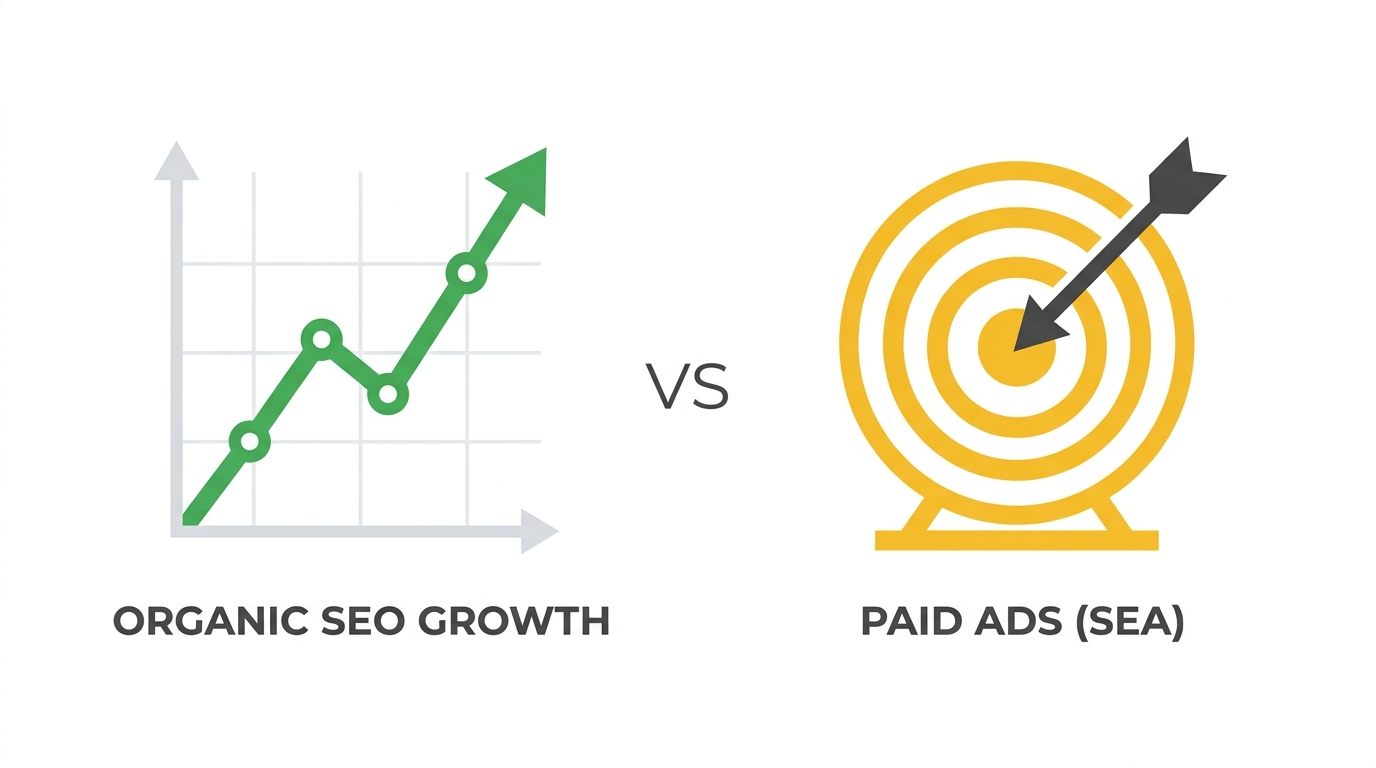
When engineering digital growth, the question is rarely whether to choose Search Engine Optimization (SEO) or Search Engine Advertising (SEA). For international businesses scaling into new territories, or Moroccan enterprises looking to establish absolute market authority, the real question is how to perfectly balance the two to create an impenetrable defensive moat around your brand.
As an auditor and digital strategist, I look at marketing through the lens of capital allocation and return on investment (ROI). Both SEO and SEA require distinct capital structures. Data shows that a hybrid approach is statistically the most profitable.
The SEA Fallacy: Addicted to the Bid
Google Ads (SEA) is incredibly powerful for capturing high-intent, bottom-of-the-funnel traffic. If a user in Casablanca searches for "Best corporate tax lawyer," they need a solution immediately. Bidding on that keyword ensures your firm appears first.
However, relying strictly on SEA is a dangerous long-term strategy. You do not own the digital real estate; you are merely renting it. According to WordStream's 2024 Industry Benchmarks, the average Cost-Per-Click (CPC) across B2B industries has inflated by over 14% year-over-year. The moment you stop feeding the machine with ad spend, your lead generation drops to zero. Furthermore, as competitors enter the market, your profit margins rapidly erode.
Technical SEO: Building Digital Equity
SEO, on the other hand, is the process of building digital equity. It is the architectural equivalent of buying the building rather than renting the office space. While it takes significant initial engineering, the long-term yield is entirely asymmetric.
- Compounding Returns: An article that ranks #1 for a high-value keyword will generate leads for years without additional variable costs. Data from BrightEdge reveals that organic search drives 53.3% of all trackable website traffic.
- Brand Authority: Users implicitly trust organic results. A massive 70-80% of search engine users ignore paid ads and focus exclusively on organic results (Source: Search Engine Journal).
- Defensive Moat: Once you establish domain dominance in a niche, it becomes exceptionally expensive and time-consuming for a competitor to dislodge you.
The Optimal Synthesis
The most sophisticated digital strategies integrate both. You utilize SEA for immediate cash-flow generation and rapid A/B testing of keyword conversion rates. Once you mathematically prove which keywords drive the highest lifetime value (LTV) clients, you deploy your SEO resources to capture those exact keywords organically.
This hybrid approach ensures short-term revenue while simultaneously constructing the long-term infrastructure necessary for sustained dominance.
Stop Renting Your Digital Real Estate.
If your business is entirely dependent on paid ads, you are vulnerable. Let's architect a data-driven SEO/SEA strategy that guarantees scalable, long-term growth.
Sources & References
- WordStream, "Google Ads Industry Benchmarks 2024" — Average CPC inflation across B2B industries. wordstream.com
- BrightEdge Research, "Organic Search Drives 53.3% of All Website Traffic" — Channel Share of Traffic report. brightedge.com
- Search Engine Journal, "70–80% of Users Ignore Paid Ads and Focus on Organic Results" — User behavior and trust in organic search. searchenginejournal.com